You walk into the weight room for the first time. Rows of barbells, dumbbells, and machines stretch before you. Everyone else seems to know exactly what they are doing. You pick up a dumbbell, put it down, and leave feeling unsure. This is how nearly every strength training journey begins — with confusion and a dose of intimidation.
The good news is that strength training is remarkably simple at its core. Your muscles respond to tension. When you lift a weight that challenges them, they adapt by getting stronger. The hundreds of exercises, programs, and techniques you see online are variations on this single principle. Master the basics, and everything else falls into place.
This guide covers everything a complete beginner needs: the fundamental movements, how to build a program, proper form cues, nutrition for muscle growth, and common mistakes to avoid. No bro-science, no complicated periodization — just the science-backed essentials that actually work.
Why Strength Training Matters
The benefits of strength training extend far beyond muscle size. Regular resistance training improves bone density, reduces the risk of osteoporosis, enhances insulin sensitivity, boosts metabolism, and improves mental health. A study published in the British Journal of Sports Medicine found that strength training is associated with a 10-17% lower risk of all-cause mortality.
As we age, muscle mass naturally declines — a process called sarcopenia that begins around age 30 and accelerates after 60. Strength training is the most effective intervention to slow or reverse this decline. Maintaining muscle mass means maintaining independence: climbing stairs, carrying groceries, playing with grandchildren, and staying active well into old age.
Beyond the physical benefits, strength training builds mental toughness and confidence. There is something transformative about proving to yourself that you can lift what you could not lift last week. Each small victory compounds.
"Strength does not come from physical capacity. It comes from an indomitable will." — While that is true, the physical capacity helps too. The beauty of strength training is that both the body and the mind grow together.
The Five Fundamental Movement Patterns
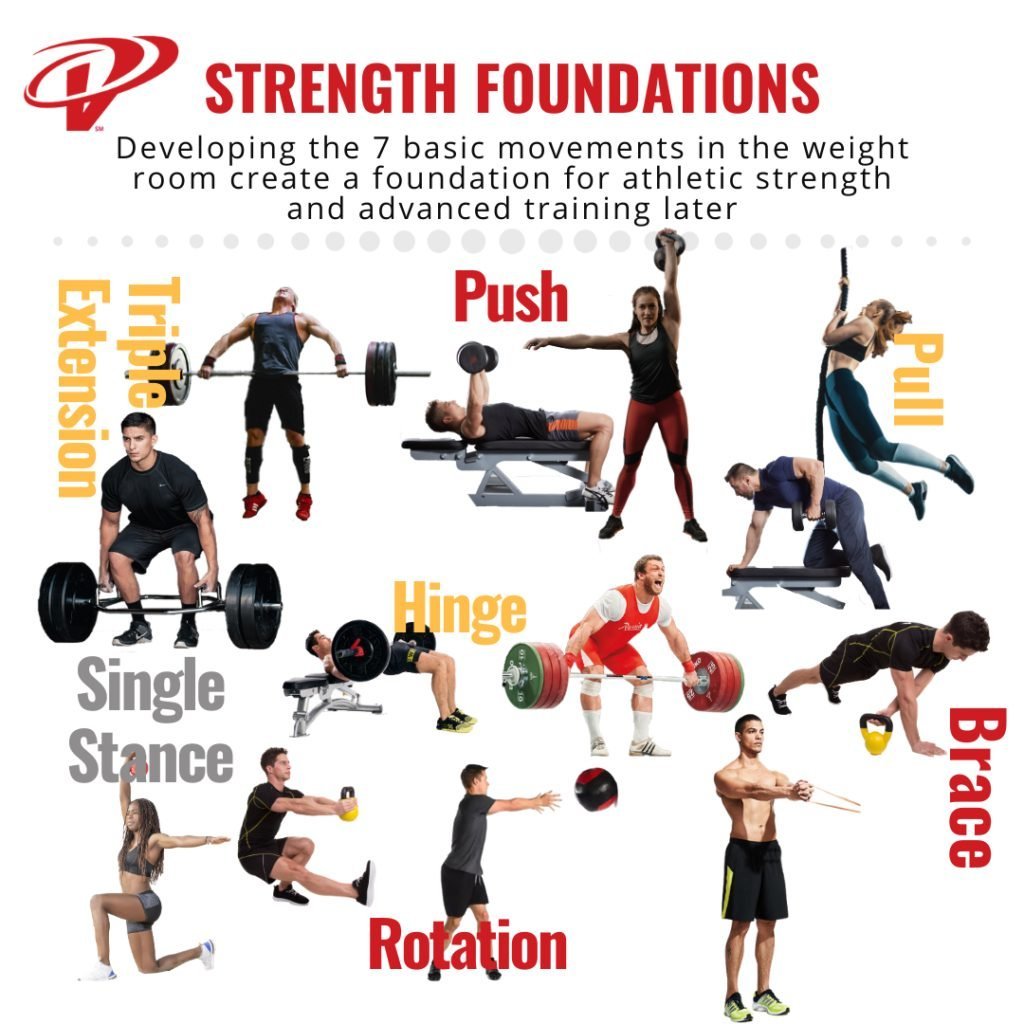
Every strength exercise is a variation of five basic movement patterns. Master these, and you have a complete full-body workout:
1. Squat pattern: Bending at the knees and hips while keeping the chest up. Exercises: bodyweight squats, goblet squats, barbell back squats. This works quads, glutes, hamstrings, and core.
2. Hinge pattern: Bending at the hips while keeping the spine neutral. Think of pushing your hips back as if closing a car door with your rear. Exercises: deadlifts, Romanian deadlifts, kettlebell swings. This targets glutes, hamstrings, and lower back.
3. Push pattern: Pushing weight away from your body. Exercises: push-ups, bench press, overhead press, dumbbell shoulder press. This works chest, shoulders, and triceps.
4. Pull pattern: Pulling weight toward your body. Exercises: rows, pull-ups, lat pulldowns, face pulls. This targets back, biceps, and rear deltoids.
5. Loaded carry pattern: Walking while holding weight. Exercises: farmer carries, suitcase carries, waiter carries. This builds grip strength, core stability, and shoulder health.
A well-rounded program includes at least one exercise from each category. For beginners, start with bodyweight versions. Master the pattern before adding weight.
Building Your First Program
A beginner strength program does not need to be complicated. In fact, simpler is better because it allows you to focus on form and consistent progression. The standard recommendation is a full-body routine three times per week, with at least one rest day between sessions.
Here is a sample beginner program that covers all five movement patterns:
Workout A: Goblet squats (3x8-12), Dumbbell bench press (3x8-12), Bent-over rows (3x8-12), Plank (3x30-60 seconds), Farmer carries (3x30 seconds)
Workout B: Romanian deadlifts (3x8-12), Overhead press (3x8-12), Pull-ups or lat pulldowns (3x8-12), Side planks (3x20-30 seconds per side), Suitcase carries (3x30 seconds per side)
Alternate A and B, training three non-consecutive days per week (e.g., Monday, Wednesday, Friday). Each workout should take 40-50 minutes including warm-up. The goal is to increase the weight or reps each week — this is called progressive overload.
The most common beginner mistake is doing too much. More exercises are not better. Stick to 5-6 exercises per session, progress them consistently, and trust the process.
Proper Form: The Non-Negotiable
Form is not about looking good — it is about safety and effectiveness. Poor form shifts tension away from the target muscles and onto joints and connective tissue. Over time, this leads to injury and stalled progress.
Neutral spine: Your spine has natural curves that should be maintained under load. Think of a straight line from your head to your tailbone. Do not round your lower back in deadlifts or arch excessively in bench press. Brace your core as if someone were about to punch you in the stomach.
Controlled tempo: Lower the weight in about 2-3 seconds (eccentric), pause briefly at the bottom, and lift in 1-2 seconds (concentric). The eccentric phase is where most muscle damage and growth stimulus occurs — rushing it means leaving gains on the table.
Full range of motion: Partial reps are sometimes useful (for specific training goals), but for general strength and hypertrophy, use the fullest range of motion you can maintain with good form. A half-squat trains different muscles than a full-depth squat.
Breathing: Hold your breath during the hardest part of the lift (valsalva maneuver) to stabilize your spine, then exhale on the easier part. Never hold your breath throughout an entire set — you will get dizzy and risk passing out.
Progressive Overload: The Engine of Growth
Progressive overload is the gradual increase of stress placed on the body during training. Without it, muscles have no reason to adapt and grow. The principle sounds straightforward, but beginners often misunderstand what "progress" means.
Progress can mean: adding 2.5-5 lbs to the bar, doing one more rep with the same weight, adding one more set, reducing rest time between sets, or improving form to recruit more muscle fibers. It does not have to mean lifting dramatically heavier every week.
For beginners, linear progression is the most effective approach. Add a small amount of weight each session (or each week) to the main lifts. When you can complete all sets and reps with good form, increase the weight by the smallest increment available. When you stall, deload — reduce weight by 10-20% for a week, then resume progression.
A common misunderstanding is that you need to train to failure on every set. Research shows that leaving 1-3 reps in reserve (RIR) produces similar muscle growth to training to failure, with significantly less fatigue and injury risk. Stop your set when you feel you have 1-2 good reps left.
Nutrition for Muscle Growth
Strength training breaks down muscle tissue. Nutrition rebuilds it. Without proper fuel, your training efforts will produce disappointing results regardless of how hard you work in the gym.
Protein: Aim for 1.6-2.2 grams of protein per kilogram of body weight (0.7-1.0 g/lb). Spread this across 3-5 meals throughout the day. Good sources: chicken breast, eggs, Greek yogurt, tofu, fish, whey protein. A post-workout meal with 20-40g of protein within a few hours of training supports optimal recovery.
Calories: To build muscle, you need a slight calorie surplus — about 200-400 calories above maintenance. This does not mean eating everything in sight. Add a protein shake, an extra serving of rice, and a piece of fruit. For fat loss while preserving muscle, a modest deficit of 200-400 calories with adequate protein is effective.
Timing: The "anabolic window" (the idea that you must eat protein within 30 minutes of training) is largely overblown. What matters more is total daily protein intake. Eating protein within 2-3 hours post-workout is sufficient for most people.
Hydration is often overlooked. Even mild dehydration reduces strength and increases perceived effort. Drink water throughout the day and during workouts — about 7-10 oz every 10-20 minutes of exercise.
Common Beginner Mistakes
1. Ego lifting: Lifting too heavy with poor form is the fastest path to injury. Leave your ego at the door. The person squatting with perfect form using light weight will progress faster than the one heaving weight with a rounded back.
2. Ignoring the basics: Chasing advanced techniques (cluster sets, myo-reps, blood flow restriction) before mastering the fundamentals is a recipe for stalled progress. Master squats, deadlifts, presses, rows, and pull-ups first.
3. No structure: Walking into the gym and doing whatever exercise feels good that day is not a program. The best program is one you follow consistently for 8-12 weeks before making changes. Write it down, track your weights, and follow the plan.
4. Skipping warm-up: Five minutes of light cardio, dynamic stretching, and a few warm-up sets with the empty bar reduce injury risk and improve performance in your working sets. Do not skip this.
5. Overtraining: More is not better. Your muscles grow during rest, not during workouts. If you are sore every day, sleeping poorly, and feeling unmotivated, you are likely doing too much. Scale back and let recovery catch up.
Strength training is a long game. The first few weeks might feel awkward. You might be sore in unexpected places. Your coordination will improve faster than your strength. Keep showing up. The person who lifts consistently for a year will be unrecognizable — not just in appearance but in confidence, discipline, and overall health. Ready to build your program? Check out detailed workout plans and video form guides at Fit Forge's Training Library.
