Buying your first motorcycle, or upgrading to a new one, is an exciting milestone. The freedom of the open road, the connection to the machine, and the community of fellow riders are waiting for you. But the motorcycle market is vast and varied, with dozens of categories, hundreds of models, and price tags ranging from a few thousand dollars for a used starter bike to well over thirty thousand for a premium touring machine. Making the right choice requires understanding not just the specifications, but how a particular bike fits your body, your riding style, and your budget.
This guide walks you through every important factor in the motorcycle buying process. We cover the major bike categories and what each is designed for, engine displacement and power considerations, ergonomics and fit, new versus used decisions, budgeting for both the bike and essential gear, and the practical steps of test riding and negotiating. By the time you finish reading, you will have a clear framework for evaluating motorcycles and choosing the one that is truly right for you.
Understanding Motorcycle Categories
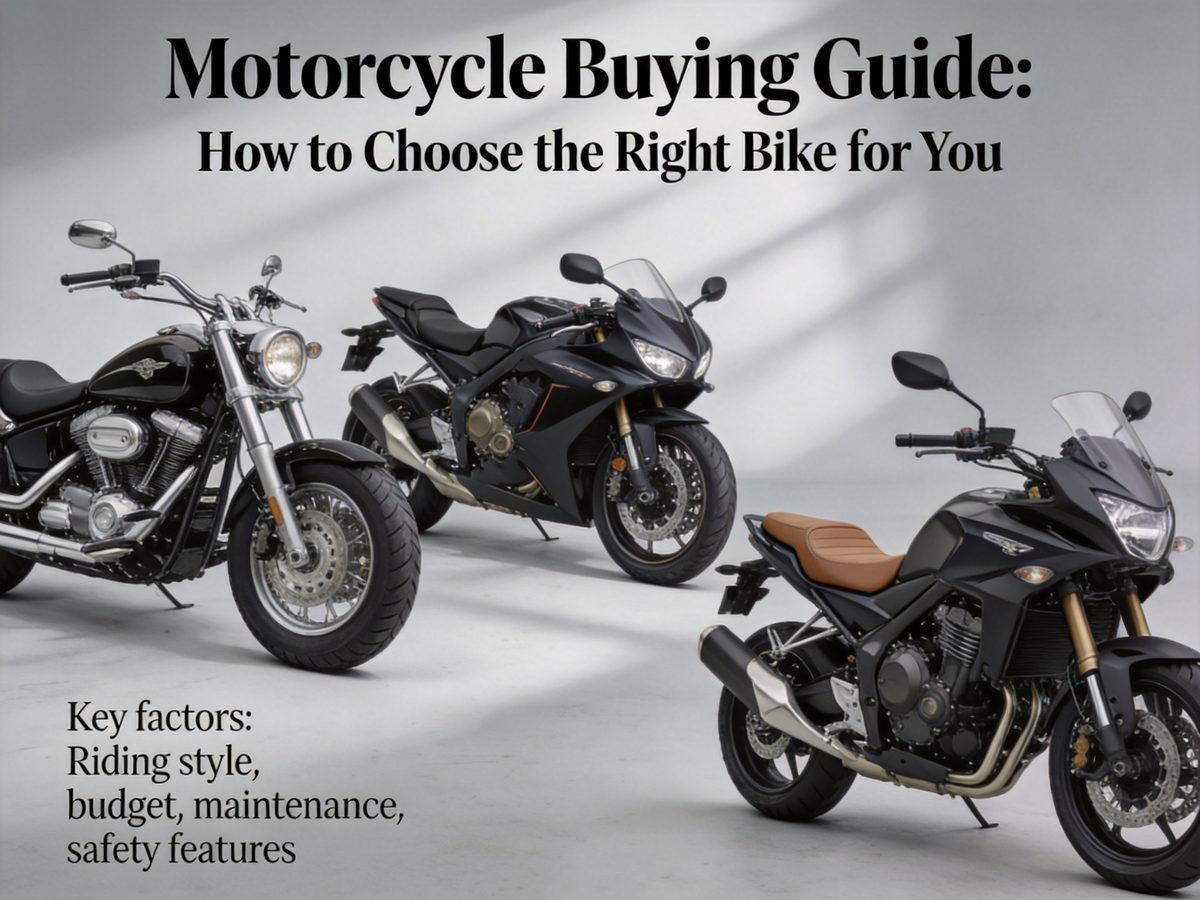
Motorcycles are typically grouped into categories based on their intended use, riding position, and styling. Understanding these categories is the first step in narrowing your search. Standard or naked bikes offer a neutral, upright riding position and versatile performance that works well for commuting, weekend rides, and even light touring. They are the most practical choice for new riders and experienced riders alike who want one bike that does most things well.
Cruisers, popularized by Harley-Davidson and Indian, feature a low seat height, forward foot controls, and a relaxed, laid-back riding position. They excel at leisurely rides on paved roads and have a strong customization culture. Sport bikes prioritize speed and handling with aggressive, forward-leaning ergonomics, high-revving engines, and aerodynamic fairings. They are thrilling on twisty roads and racetracks but can be uncomfortable for long-distance riding. Adventure bikes combine on-road comfort with off-road capability, featuring long-travel suspension, upright ergonomics, and large fuel tanks for extended range. Touring bikes are designed for covering long distances with maximum comfort, featuring wind protection, spacious luggage, and amenities like heated seats and premium audio systems. Dual-sport motorcycles are lightweight, off-road-capable machines that are also street legal, making them excellent for exploring dirt roads and trails.
According to the Motorcycle Industry Council, there were over 8.4 million motorcycles registered in the United States as of 2023, with the average rider age being 48. The market has seen a notable increase in younger riders and women entering the sport over the past five years.
Engine Size and Power Delivery
Engine displacement, measured in cubic centimeters or cc, is often the first specification new riders look at. But displacement alone does not tell the full story. How the engine delivers its power matters just as much. A 650cc parallel twin engine found in many standard bikes delivers smooth, linear power that is manageable for new riders. A 600cc four-cylinder supersport engine produces significantly more peak horsepower and revs much higher, requiring more skill to ride smoothly.
For new riders, the sweet spot for engine displacement is between 300cc and 500cc for lightweight bikes, or 500cc to 700cc for standard and adventure models with more relaxed power delivery. These bikes provide enough power for highway cruising without being overwhelming. Experienced riders looking for more performance typically move to 600cc to 1,000cc sport bikes, 1,200cc to 1,800cc cruisers, or 800cc to 1,300cc adventure and touring machines. Always consider the power-to-weight ratio rather than displacement alone. A lightweight 400cc bike can feel faster than a heavy 900cc cruiser because of its superior power-to-weight ratio and agility.
Ergonomics and Fit: The Most Overlooked Factor
A motorcycle that does not fit your body will never be comfortable, regardless of how impressive its specifications are. Seat height is the most obvious fit factor. Your feet should be able to reach the ground comfortably, ideally flat-footed or at least on the balls of your feet. Many manufacturers offer lowered seat options or adjustable suspension to accommodate shorter riders. Handlebar reach determines your upper body position. Your wrists should not bear weight when gripping the bars, and your elbows should have a slight bend. Footpeg position affects knee angle and overall comfort. Forward pegs are common on cruisers, while rear-set pegs are typical on sport bikes.
The best way to evaluate fit is to sit on multiple bikes at a dealership. Wear the gear you plan to ride in, including your boots and jacket. Ask a salesperson to hold the bike upright while you climb aboard and assume your riding position. Close your eyes and assess how natural the position feels. Can you easily reach all controls without stretching? Does your neck feel strained looking forward? A ten-minute test sit reveals more than hours of online research. Do not rush this step, because a bike that fits poorly will collect dust in your garage.
New Versus Used: Making the Smart Choice
For first-time buyers, a used motorcycle is almost always the better financial decision. Motorcycles depreciate rapidly in their first few years, and you can find excellent condition used bikes with low mileage for a fraction of their original price. A used Japanese motorcycle from Honda, Yamaha, Kawasaki, or Suzuki that is three to eight years old offers outstanding reliability at a reasonable price. You will also be less worried about minor drops and scratches, which are common as new riders develop their low-speed handling skills.
If you decide to buy new, you get the latest technology, a full factory warranty, and the satisfaction of being the first owner. New bikes are also easier to finance, as lenders offer better terms for new vehicles. The trade-off is higher cost and steeper depreciation. Whichever path you choose, have any used motorcycle inspected by a qualified mechanic before purchase. Check for maintenance records, accident history through services like Carfax, and signs of abuse such as worn tires, leaky seals, or unusual engine noises. A pre-purchase inspection costing a hundred dollars or so can save you thousands in unexpected repairs.
The perfect motorcycle is the one that fits your body, matches your skill level, excites you every time you see it, and fits your budget including the essential gear you need to ride safely. Take your time, do your research, and trust your instincts when you find the right one.
For in-depth motorcycle reviews, maintenance guides, and rider community discussions, visit MotoPulse. You will find comprehensive resources covering everything from beginner bike recommendations to advanced riding techniques.